


Just as the Great Depression inspired Hollywood’s Golden Age, the COVID-19 pandemic had a significant impact on how and where people consume online media. Shortly after, new content formats started gaining traction, and generative AI became more advanced. This completely transformed the content marketing industry landscape, compelling businesses to adapt to stay ahead of the curve.
What is content marketing? (A brief refresher)
The classic definition of content marketing, according to the Content Marketing Institute, is:
“A strategic marketing approach focused on creating and distributing valuable, relevant, and consistent content to attract and retain a clearly defined audience — and, ultimately, to drive profitable customer action.”
In other words, companies attract prospects and customers to their sites or social media pages and turn those eyeballs (and the people behind them) into sales. Successful content marketing companies have specific and data-driven strategies for delivering the right content to the right people at the right time. They nurture those relationships, feed prospects more relevant content, and ultimately convert them to buyers (or build loyalty with current customers/clients).
Content marketing:
- Is a timeless marketing technique. It has its roots in the 1880s. Sponsored content and direct mail-driven lead-generation streams have been around for decades.
- Changed dramatically as a result of automation. Technology became the jet fuel that enabled marketers to market with more precision, speed, personalization, and analytics.
- Continues to evolve due to AI, machine learning, and sophisticated SEO techniques. Today’s content marketer can assess who is consuming what types of content, which patterns of content (message, media, time of day, location, and device) perform best, and fine-tune their approach at the drop of a hat.

How has the pandemic changed content marketing?
Media consumption was undergoing a digital transformation well before the pandemic, with the growing popularity of online news sites, social media platforms, and streaming services. But once the pandemic hit, things accelerated. People started spending more time online and consuming even more digital content.
In fact, video content viewership increased by 60%, according to a Nielsen study.
Naturally, businesses had to adapt by building remote-first content marketing strategies. This spawned the rise of online events and immersive virtual experiences as well as multichannel content distribution.
New formats started gaining popularity, as voice and audio content bridged the “connection gap” and humanized digital interactions. Podcasts in particular exploded in popularity, with 55% of Americans over the age of 12 now being monthly podcast consumers.
Interestingly, these aren’t just fleeting content marketing trends that only lasted during the height of the pandemic. Many of these changes have become permanent fixtures in content marketing today. In other words, these COVID-19 digital content experiences are here to stay.
Meanwhile, as workers became more comfortable with remote work environments, the structure of content marketing teams also evolved. Gallup reports that six out of 10 employees with remote-capable jobs prefer a hybrid work arrangement, while around one-third prefer a fully remote setup.
As a result, many content teams have adopted hybrid structures to offer more flexibility. In the process, measurement and attribution for content performance metrics have also adapted to support these new team structures. Tools with automated data collection and real-time tracking capabilities now take center stage in content marketing analytics.
New Frontiers with AI Content Marketing
The pandemic isn’t the only thing that’s transformed the content marketing industry. With the growing adoption of generative AI, content marketing teams have to navigate a “new normal” dominated by AI-powered content strategies.
As generative AI tools, particularly ChatGPT, became more capable, businesses were able to speed up and scale their content production. Many embraced complete content automation, where AI generates entire articles, social media posts, or videos.
For businesses that still want to focus on human-led content creation, a hybrid marketing option can significantly improve efficiency. Using AI to streamline certain aspects of the production process, mainly content ideation and briefing, allows human teams to produce the actual content. A study by eMarketer even found that 55% of marketers use AI to ideate content.
Seven Rules of Content Marketing in The New Normal
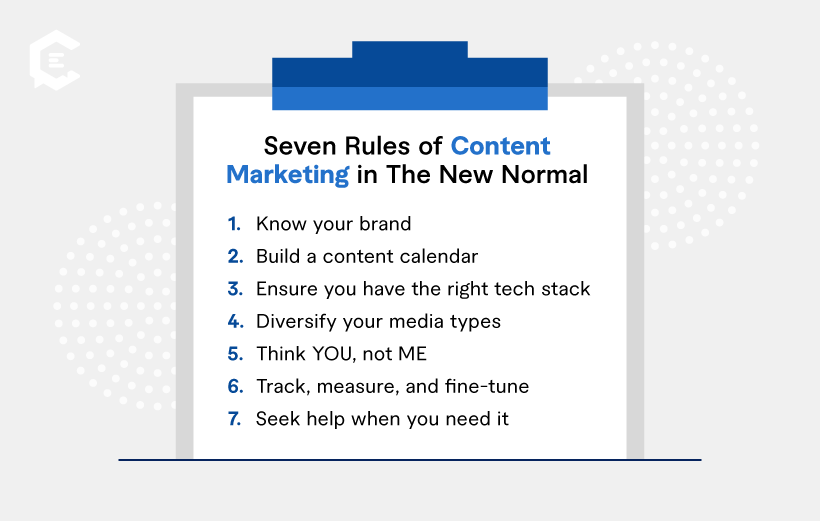
Considering the changes discussed above, let’s check out some of the top rules to guide your content marketing strategy in the new normal.
1. Know your brand
Your content is a key part of your entire marketing platform. What do you want to be known for as a company? What’s your tone (formal, whimsical, entertaining)? How are you different from — and better than — everyone else in your product or service category?
2. Build a content calendar
Some of your content will be “evergreen” (or useful year-round) and some may specifically relate to a season. But every piece of content must have a purpose and somehow tie into your customer experience and sales process. Use a visual content calendar to plan out your content and make strategic publishing decisions.
3. Ensure you have the right tech stack
With the popularity of AI content marketing, the right tech stack is essential to keep up with the competition. Invest in the right AI-powered tools to support various aspects of your content marketing efforts. This may include ideation, briefing, content production, and content distribution.
4. Diversify your media types
Content isn’t just blog posts. From video to livestreams to podcasts, there’s a huge selection of content types you can experiment with. Diversify your digital marketing strategy to include these different media types so you can cater to a wider audience.
Incorporate unique imagery, videos, graphics, polls, and other creative approaches to attract viewers. Invest in podcasts, livestreams, and immersive digital experiences to connect with your audience.
Short-form video, in particular, is gaining traction across industries and social media platforms. Over 90% of Gen Z and Millennials watch short-form videos at least sometimes or frequently, with YouTube, Facebook, TikTok, and Instagram being the most popular platforms.
Ramp up your video content marketing efforts with product demos, how-tos, and entertaining stories. You can even share compelling video customer stories to build trust.
Headlines must be powerful and pithy. Even for B2B content marketing, white papers and research reports need to be compelling to read. After all, professionals are consumers too.
5. Think YOU, not ME
No one wants to read a post or watch a video that’s all about you or your product. Consider what your audience wants, which formats they prefer, and which pain points to address. You can even segment your audience into different personas and develop more personalized content to address the specific needs of certain subgroups.
When you develop content that focuses on the audience, it’s likely to resonate with them, generating better engagement overall.
6. Track, measure, and fine-tune
Take advantage of the data that’s available to you, and don’t “spray and pray” with your content. Monitor your content performance metrics regularly to identify patterns and uncover insights about what your audience prefers. This will help you match your messages and cadence to better align with your audience’s behavior and preferences.
7. Seek help when you need it
Engage professionals who understand your industry and content marketing. Great writers can be useful, but true content marketers know how to turn those words or pictures into profits. Create a cross-generational, multi-skilled work team that has both business acumen and creative chops.
Some companies have had to trim their marketing and content staffs, but outsourcing to integrated groups of teamlancers is a viable option. Selecting the right partners can be more cost-effective than in-house solutions and can bring a whole new skill set and perspective to your business.
Don’t rule out managed content creation either. This marketing specialty lets you outsource the entire content management process to the right team of content producers.

Content Marketing Has Evolved
Just as technology and new media platforms changed the content marketing industry over the past decade, the COVID-19 pandemic left a lasting and profound impact. What we’ve learned:
- Giving people the information and insights they really need is paramount.
- Workgroups look different now, and content teams are more diverse than ever, located worldwide.
- Businesses are more mindful of how they spend every marketing dollar.
- AI and machine learning will continue to accelerate performance data reporting and guide decision-makers on how to respond.
However, one thing hasn’t changed since the 1880s. People still want to read, view, and engage with words and pictures that make them smarter, make them laugh or cry, give them insights into how to solve problems, and find where to go for the things they need.
Need help creating more impactful content to adapt to the new normal? ClearVoice can help. Our team of experts offers a range of content solutions to scale your marketing efforts. Get in touch with a content specialist today to get started.