


Social media is everywhere — but does it actually help your SEO? Marketers have debated the role of social signals for years, and you’ll find a lot of conflicting information online.
So, what’s the real relationship between social signals and SEO? Does Google use them to determine rank, or are they just vanity metrics with no direct impact on SEO? Keep reading to find out.

What are social signals?
Social signals refer to the likes, comments, shares, and other interactions your content receives on social media platforms. They represent how often people engage with your content across channels like Instagram, TikTok, YouTube, LinkedIn, and more.
Do social signals affect SEO ranking?
Social signals are not a direct ranking factor, according to Google. This is a stance they’ve maintained since 2014, when Google’s Matt Cutts shared a statement in a video. In other words, likes, shares, and comments aren’t used in Google’s algorithm to decide how a page ranks.
However, many SEO professionals disagree with dismissing social signals entirely because they’ve observed a strong correlation between higher social engagement and better organic rankings.
For example:
- Backlinko lists social signals among its top eight ranking factors.
- CognitiveSEO analyzed 23 million social shares and found a clear correlation between strong social activity and higher search visibility.
While social signals may not send you soaring up the SERPs, they can amplify your overall online presence. More likes, shares, and mentions improve your content’s visibility on social platforms, which can drive more clicks, traffic, and backlinks.
It can also help get your brand mentioned in AI search platforms and large language models (LLMs), because more online mentions typically lead to more credibility.
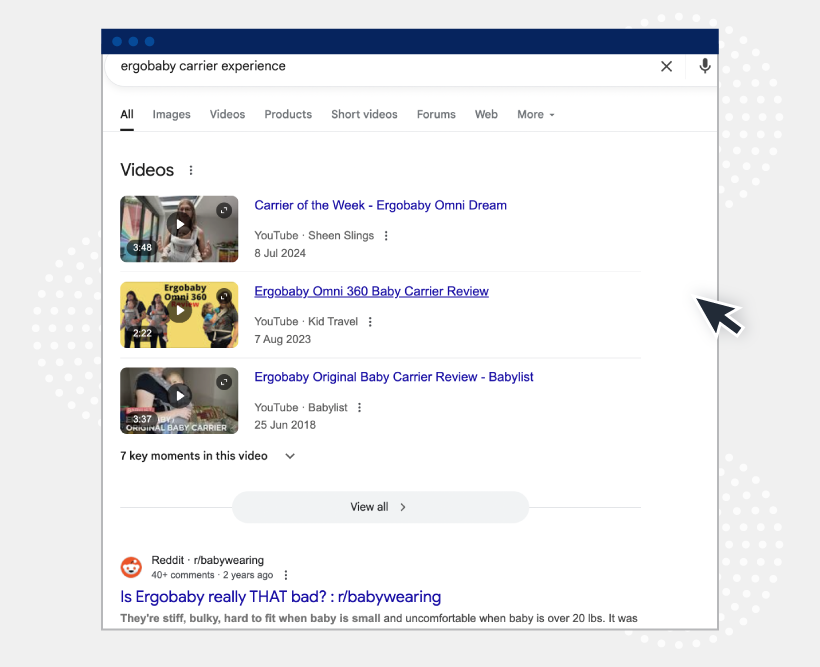
In some cases, content with strong social engagement also appears directly in search results. For example, if you search for “Ergobaby carrier experience,” you’ll often see top results from YouTube and Reddit, two platforms where social activity drives visibility.
How are social signals used in SEO?
If there’s really some correlation between your social media presence and your organic ranking, how does it all work? Let’s take a look at the different ways in which social media can impact SEO.
Increased traffic to your site
Search engines evaluate user behavior signals, such as time on site, pages per session, and click-through rates, when determining how relevant and valuable your content is. If your site isn’t getting enough traffic, it’s harder to improve these signals and, in turn, your search visibility.
One of the most effective ways to tackle this challenge is by using social media to drive high-quality traffic. Sharing your content on platforms like YouTube, LinkedIn, TikTok, or Reddit helps you reach the right audience faster.
When more people visit your site and engage with your content, it can:
-
Improve user behavior signals over time
-
Help search engines better understand and index your content
-
Potentially speed up how quickly your pages start ranking for relevant keywords
Opportunity for backlinking
Backlinks remain one of the strongest off-page ranking factors. According to Semrush, both the number of referring domains and the quality of backlinks are vital drivers of higher search rankings.
Earning those links, however, requires high-quality, valuable content. Reputable sites only link to content they trust, so consistently publishing content that’s relevant and useful to your audience is essential.
The challenge? If your site is new or not yet ranking, people who might want to link to your content may not even know it exists. That’s where social media distribution comes in. Sharing your content widely gets it in front of more people, increasing the likelihood that someone will read it — and link to it.
Boosting credibility and authority
When ranking a page, search engines look at topical authority to determine how relevant and trustworthy your content is for a given search. The more expertise and depth your content demonstrates, the more likely it is to rank well.
Publishing high-quality content is essential for building that authority and gaining credibility with both search engines and users. You can amplify this effect by sharing your content on social media, which can generate more social signals. In turn, this can lead to greater visibility, traffic, and credibility for your brand.
More AI and LLM search mentions
AI-driven search has a growing role in SEO. Features like Google’s AI Overviews (AIO) and AI Mode, as well as LLMs like ChatGPT, Claude, and Perplexity, pull insights from a wide range of sources, including forums, reviews, and social media.
This makes brand visibility — including social signals — across social platforms more important than ever. The more your content, products, or brand are mentioned and discussed online, the greater the chance AI systems will surface you in generated summaries and snippets. Increasing your social signals can help your brand get cited in AI-generated results more often.
Are social signals identical to backlinks?
Not exactly. While links from social platforms can be indexed by search engines, many are marked as nofollow or ugc and don’t pass PageRank the same way traditional backlinks do.
That said, social sharing still plays an important indirect role in earning backlinks:
-
Sharing your content on social platforms increases its visibility.
-
The more people who see your content, the greater the chance someone will reference or link to it from their own site.
-
These earned backlinks from third-party sites do contribute directly to your SEO.
So, while social links themselves don’t carry much weight as ranking signals, social visibility helps your content attract the high-quality backlinks that do.
Best Social Media Platforms for SEO
Let’s take a look at the best social media platforms for SEO. This will give you an idea of where to focus your efforts to improve organic rankings.
YouTube
As the #2 ranking site globally, YouTube gets a ton of visibility in search results. In fact, YouTube videos often rank prominently in relevant search results, especially for “how-to” or tutorial-style queries.
AI systems also scrape video titles, transcripts, and descriptions, which gives you more visibility via generative snippets. So, improving your YouTube SEO is an effective way to improve your social signals and online visibility.
Reddit has become one of the most visible domains in Google’s organic search results, now ranking as the fifth-highest visibility domain, according to Amsive. Google increasingly prioritizes authentic, human-led discussions, and Reddit threads frequently appear in both traditional SERPs and AI search engines and LLMs.
This makes Reddit a powerful platform for boosting brand visibility and social signals and capturing search traffic. Focus on contributing to high-value discussions where your audience is already active. Detailed answers, expert insights, and in-depth comparisons tend to perform best.
TikTok
When your videos earn likes, shares, and comments, these social signals can boost your visibility within TikTok’s algorithm and increase the chances of your content appearing in Google’s “Short videos” section.
By optimizing your videos with relevant keywords, captions, and hashtags, you can amplify engagement and reach a wider audience. The more your content is shared and discussed, the greater the opportunity to drive traffic to your site— supporting your SEO efforts indirectly.
Instagram Reels and visual content are showing up more often in Google search results, especially for reviews, tutorials, and step-by-step guides.
Strong engagement signals help your content gain traction on the platform. And the more your posts perform on the platform, the higher the likelihood they’ll surface in relevant search results.
Optimizing your captions, alt text, and hashtags can improve both in-platform reach and external visibility, making Instagram an effective channel for boosting your overall content exposure.
Pinterest often ranks well in Google’s image and idea-focused searches. And posts that earn strong social signals tend to surface more prominently on Pinterest and in search results as well. Invest in Pinterest SEO by optimizing your descriptions, titles, and hashtags to increase visibility and drive qualified traffic to your site.
Quora
Quora answers frequently appear in Google results for question-based searches, making it a valuable platform for driving visibility. Because LLMs are often trained on Q&A platforms, building a presence on Quora can also increase your chances of brand mentions in AI-generated summaries and search snippets.
Combining Social Media and SEO for Better Visibility
Social signals may not directly boost your search engine ranking, but they affect your search visibility in other ways, from more authority to LLM citations. The bottom line: Social media and SEO work best together. By creating shareable, high-quality content and promoting it strategically, you can strengthen your online presence and improve your search performance.
Need help creating top-notch content to improve your search visibility? ClearVoice offers a range of content solutions to help you rank in traditional search and LLMs. Connect with a content specialist to get started.